Incheon Airport to Seoul: Complete Transportation Guide
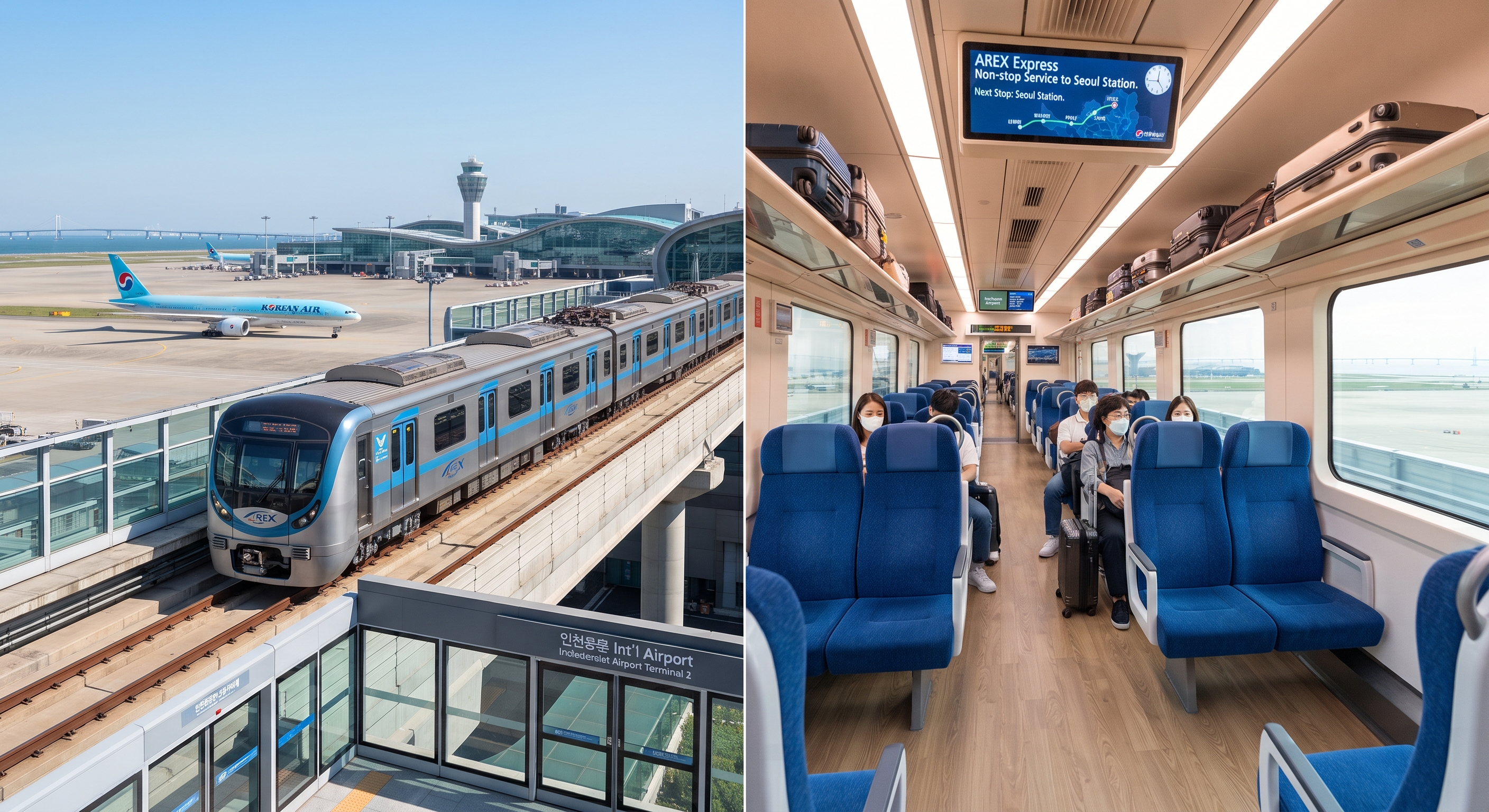
You’ve just landed at Incheon International Airport after a long flight, cleared customs, and now face the roughly 50-kilometer journey into Seoul. The good news: Incheon is one of the world’s best-connected airports, with multiple reliable options to reach the city center. The challenge is picking the right one for your budget, destination, luggage situation, and energy level.
This guide breaks down every major transportation method—from the express train to limousine buses, taxis, and even the KTX—so you can make an informed choice before you land.
AREX (Airport Railroad Express): The Most Popular Choice
The Airport Railroad Express, or AREX (공항철도), is the go-to option for most travelers, and for good reason. This dedicated rail line runs directly from Incheon Airport to Seoul Station, with two service types.
Express Train
The nonstop express train covers the distance in 43 minutes flat, departing every 30–40 minutes from around 5:20 AM to 10:40 PM. It runs from Incheon Airport Terminal 2, stops at Terminal 1, then goes directly to Seoul Station with no stops in between. As of 2024, tickets cost around ₩9,500–₩11,000 (roughly $7–8 USD) for adults.
The express train offers spacious seats, plenty of luggage space, free Wi-Fi, and power outlets. The catch? It only takes you to Seoul Station. From there, you’ll need to transfer to Seoul’s subway system or grab a taxi to your final destination.
All-Stop Commuter Train
The all-stop AREX train is slower (about 60–70 minutes to Seoul Station) but significantly cheaper at around ₩4,750 ($3.50 USD). It stops at 11 stations between the airport and Seoul, including useful transfer points like Hongik University (Hongdae), Digital Media City, and Gongdeok. Trains run every 6–12 minutes throughout most of the day, making it very convenient if you don’t mind the extra time.
Best for: Solo travelers or pairs with moderate luggage heading to central/western Seoul, budget-conscious travelers, anyone comfortable navigating the subway.
Limousine Bus: Door-to-Door Comfort
Airport limousine buses (리무진 버스) offer a middle-ground solution: more comfortable than the train, cheaper than a taxi, and with routes to specific neighborhoods and hotels across Seoul.
How It Works
Roughly 15–20 different limousine bus routes serve various parts of Seoul and beyond. Routes are numbered (6001, 6015, 6701, etc.), and each one stops at major hotels, transit hubs, and landmarks in specific districts. For example:
- Route 6001: Dongdaemun, Myeongdong, Namdaemun
- Route 6015: Gangnam, COEX, Jamsil
- Route 6701: Itaewon, Yongsan Station
- Route 6002: Gwanghwamun, City Hall, Seoul Station
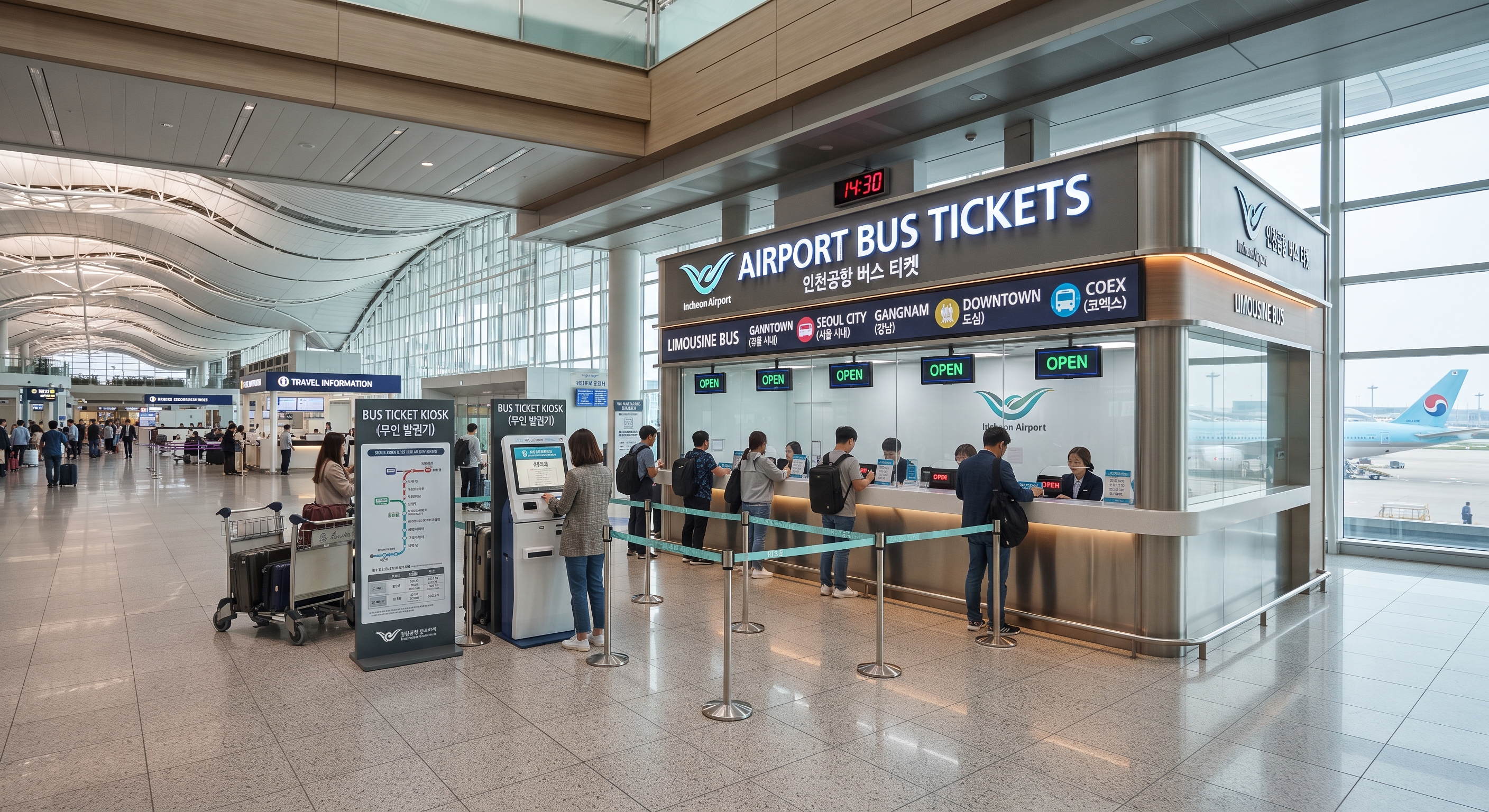
Tickets typically cost ₩16,000–₩17,000 ($12–13 USD) for most Seoul destinations. You can buy tickets at clearly marked counters in the arrivals hall or sometimes pay directly on the bus using a T-money card or cash.
Buses run from early morning (often starting around 5 AM) until late evening, with 15–30 minute intervals depending on the route. Travel time varies widely—expect anywhere from 60 to 100+ minutes depending on your destination and Seoul traffic.
Pros and Cons
The limousine bus shines if your hotel or destination is on a direct route, especially with heavy luggage. You stay seated the whole way, and there’s ample luggage storage underneath. However, you’re at the mercy of Seoul traffic (especially during rush hours), and if your stop is toward the end of the route, the journey can feel long.
Best for: Travelers with heavy luggage, groups who can split the cost, anyone staying near a limousine bus stop, first-time visitors who prefer a straightforward option.
Taxi: Maximum Convenience at a Price
Taxis from Incheon Airport are clean, metered, and honest—no need to worry about scams. The taxi stands are well-organized just outside the arrivals hall, with clear signage and attendants to help.
Types of Taxis
You’ll see three main types:
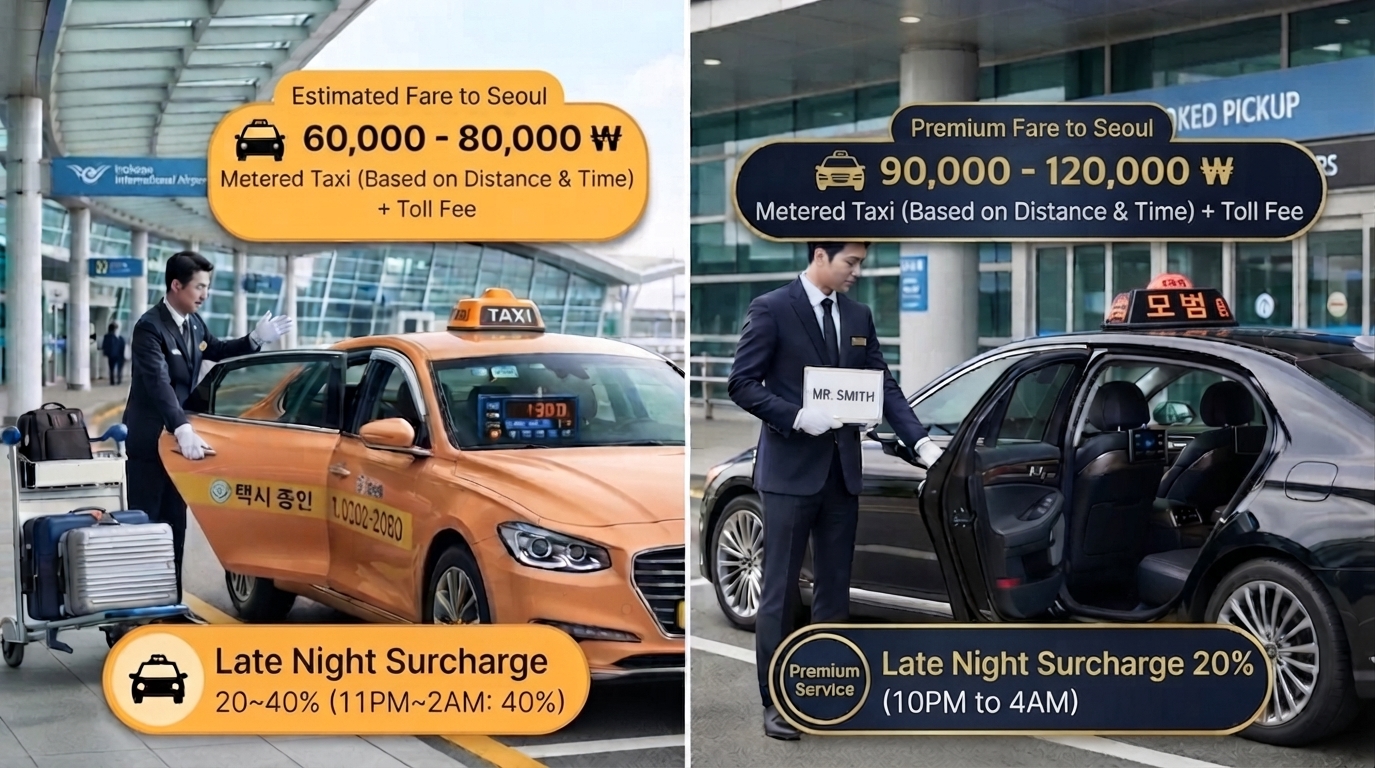
Regular taxis (orange or silver) charge a standard metered fare. Expect to pay roughly ₩60,000–₩80,000 ($45–60 USD) to central Seoul, depending on your exact destination and traffic. The fare includes a small airport surcharge.
Deluxe taxis (black with a yellow sign) offer larger, more comfortable vehicles and drivers with better English skills. They cost about 40% more—typically ₩90,000–₩120,000+ to Seoul.
International taxis can be pre-booked and guarantee an English, Chinese, or Japanese-speaking driver, but they come at a premium.
All fares increase if you hit heavy traffic or travel late at night (10 PM–4 AM surcharge applies). The ride typically takes 50–80 minutes depending on your destination and traffic conditions.
When Taxis Make Sense
If you’re traveling with 3–4 people, splitting a taxi becomes economical—potentially cheaper per person than the limousine bus and much faster than the all-stop train. Taxis also make sense if you’re arriving very late or very early when train/bus frequency is lower, or if you have multiple large bags and small children in tow.
Best for: Groups of 3–4, late-night/early-morning arrivals, travelers with excessive luggage, anyone headed to areas poorly served by trains or buses.
KTX: The Fast Track to Other Cities (and Gangnam)
Most travelers don’t realize that KTX high-speed trains depart directly from Incheon Airport. While primarily designed to connect the airport to other major Korean cities like Busan, Daegu, and Gwangju, the KTX also stops at Suseo Station in southern Seoul (Gangnam area) in just 30 minutes.
Tickets to Suseo cost around ₩9,000–₩14,000 depending on train type (KTX vs. slower ITX). Trains don’t run as frequently as AREX—usually every 1–2 hours—so you’ll need to check the schedule in advance via the Korail website or app.
Best for: Travelers heading to Gangnam, Songpa, or other southeastern Seoul areas; anyone continuing to other Korean cities without needing to enter central Seoul.
How to Choose: Decision Framework
Still not sure? Here’s a quick decision tree:
Tightest budget? → All-stop AREX
Fastest to Seoul Station? → Express AREX
Headed to Gangnam/southern Seoul? → KTX to Suseo or limousine bus 6015
Group of 3–4 people? → Split a taxi
Heavy luggage + going to Myeongdong/Dongdaemun/specific hotel? → Limousine bus
Arriving after 11 PM or before 6 AM? → Taxi or check last AREX/bus times
Final Tips for a Smooth Journey
Whichever option you choose, pick up a T-money card at a convenience store in the airport arrivals hall. This rechargeable transit card works on AREX (all-stop version), Seoul subway, city buses, and even convenience store purchases. It’ll save you time and a small amount on each subway/bus ride.
Download Naver Map or Kakao Map on your phone before you land—Google Maps works poorly in Korea. These apps show real-time public transit directions, walking routes, and even taxi fare estimates.
Finally, if you’re arriving at Terminal 2, note that it serves mainly Korean Air and SkyTeam alliance partners. Terminal 1 handles most other carriers. Both terminals have all transportation options, and a free shuttle bus connects them in about 5 minutes if needed.
Getting from Incheon Airport to Seoul is genuinely straightforward once you understand your options. Pick the method that matches your priorities—speed, cost, comfort, or convenience—and you’ll be exploring Seoul’s neighborhoods in no time.